is the Old Testament Christian?...
Tuesday, March 17, 2009
I've just finished reading 2 Samuel, and have once again been struggling with the apparently bloodthirsty God found in its pages, and how we understand this portrayal of God as followers of the Prince of Peace. And then I came across this interesting post by Matt Stone at Glocal Christianity, which explores how, as Christians, we must read the Old Testament through the reframing lense of the New Testament. Matt argues that we cannot see the Old Testament in and of itself as a 'Christian text', since it is clearly Jewish and is upheld by other faiths as Scripture even though they might come to differing conclusions about God. If we follow this line, the Old Testament becomes a 'Christian text' when it is reframed by the New, such that we reinterpret what we find there. Matt writes:
"I find the movie Sixth Sense provides a good analogy. If you have seen that movie, starring Bruce Willis, then you’d know that the ending of the movie has a killer twist. In the final moments Bruce Willis’ character has a revelation that reframes everything that was going on up to that moment.... The realization affects his identity and transforms his entire story.... For Christians the coming of Christ is, similarly, a killer twist. Jesus transforms our understanding of God, and hence, our understanding of the Old Testament and how we read it. Reading the Old Testament in isolation from the New Testament is like watching Sixth Sense but walking out fifteen minutes before the climax. You’ll never understand Christianity by viewing it that way, and you’ll never truly understand the Old Testament by reading it that way."
If I understand Matt correctly, the New Testament is the Christian's 'text' (in a Derrida sense) - our interpretive framework through which we see the world, including the Old Testament. Of course, Matt makes a huge leap in the final line of the above quote as other faiths would certainly argue against needing the New Testament in order to "truly understand the Old Testament", but as a Christian believer myself I'm happy to go along with him here!
The question remains though... what do we do with the Old Testament narratives of the boodthirsty God and the faithfulness of his people being seen in their willingness to comit mass slaughter? Do we simply reject such texts as ancient misconceptions of God, based on the new understanding arising from the teaching and sacrificial example of Jesus, or is there a more subtle way to reframe the Old Testament?
Read Matt's whole post here
"I find the movie Sixth Sense provides a good analogy. If you have seen that movie, starring Bruce Willis, then you’d know that the ending of the movie has a killer twist. In the final moments Bruce Willis’ character has a revelation that reframes everything that was going on up to that moment.... The realization affects his identity and transforms his entire story.... For Christians the coming of Christ is, similarly, a killer twist. Jesus transforms our understanding of God, and hence, our understanding of the Old Testament and how we read it. Reading the Old Testament in isolation from the New Testament is like watching Sixth Sense but walking out fifteen minutes before the climax. You’ll never understand Christianity by viewing it that way, and you’ll never truly understand the Old Testament by reading it that way."
If I understand Matt correctly, the New Testament is the Christian's 'text' (in a Derrida sense) - our interpretive framework through which we see the world, including the Old Testament. Of course, Matt makes a huge leap in the final line of the above quote as other faiths would certainly argue against needing the New Testament in order to "truly understand the Old Testament", but as a Christian believer myself I'm happy to go along with him here!
The question remains though... what do we do with the Old Testament narratives of the boodthirsty God and the faithfulness of his people being seen in their willingness to comit mass slaughter? Do we simply reject such texts as ancient misconceptions of God, based on the new understanding arising from the teaching and sacrificial example of Jesus, or is there a more subtle way to reframe the Old Testament?
Read Matt's whole post here
Labels: musings, post-modernity, theology


joining the conspirators...
Tuesday, September 30, 2008
 In preparation for a round table discussion with Tom Sine, that I'm involved in tomorrow, I've just read the first two chapters of The New Conspirators (I thought I'd better!)
 The chapter 'Emerging, Missional, Mosaic and Monastic' is an excellent, and pretty up-to-date, overview of what Sine describes as 'four streams of renewal' in the church at present (the four streams being those in the chapter title).
Last Friday I was interviewed by BBC Radio Merseyside as part of the run up to 'Back to Church Sunday', and was asked if I was concerned by the state of the church and, in particular, by its decline. I said that I wasn't, because I was hearing so many stories of new life and (to use the phrase) 'fresh expressions' of church that were much more rooted in the realities of communities, cultures and real life. I mentioned that, for me, a faith that didn't touch base with, and affect, reality was a faith not really worth having!
For people who are concerned about the state of the church, the first two chapters of Tom Sine's latest book will come as both an encouragement and a challenge. An encouragement as you read of the many ways in which new communities of followers of Jesus are taking root and making a difference, and a challenge as your eyes are opened to these new realities and your existing church (and faith) paradigms are shaken, even subverted. The kingdom of God is, of course, so much bigger than what we've allowed it to become in our Christian sub-cultures, and Sine's book is a wake up call to join in with the missio dei.
I love the invitation at the start of the book to "become a part of something 'really, really small,' a quiet conspiracy that is destined to change our lives and God's world." (p23) I'm really looking forward to reading the rest of the book and to meeting and discussing with Tom Sine tomorrow.
Labels: church, community, mission, post-modernity
landing the plane...
Tuesday, February 05, 2008
'This' is an interesting reflection from Tony Jones, that relates to the question I was posing in my last post. Go read...
Labels: post-modernity, theology
lost on the way...
Tuesday, January 15, 2008
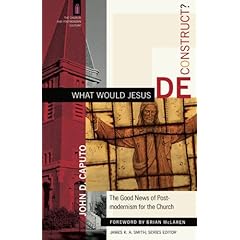
 "There are two kinds of spiritual journeys or two ways to "be on the way" as Caputo would put it, the first (which is all too familiar to many of us evangelicals) is to know the way ahead of time and then just try your hardest to get there, the second is to be on a trek to find the way but all the while being a bit lost. The postmodern person understands that being lost and at the same time being "on the way" are entirely compatible. Far from falling into the black abyss of relativity that some critics might fear, this kind of a spiritual journey boasts a healthy Christian understanding of the via negativa."
The above quote, which I find really helpful, comes from a post by Charlie Lyons Pardue engaging with John Caputo's What Would Jesus Deconstruct? Read the whole post 'here'.
Labels: post-modernity, spirituality, theology
who's afraid of postmodernism?...
Tuesday, April 17, 2007
 I've just finished reading James K A Smith's Who's Afraid of Postmodernism? Taking Derrida, Lyotard, and Foucault to Church, and would say that it's essential reading for anyone who is engaged in the emerging church 'conversation' or is concerned about being missional in the culture(s) of postmodernity. Smith takes a fresh look at what he refers to as the 'bumper sticker' quotes of Derrida ("There is nothing outside the text"), Lyotard ("incredulity towards metanarratives") and Foucault ("power is knowledge"), arguing that by pulling these popular quotes out of the context from which they originate (the original texts of the respective writers) we have largely misunderstood the authors' intentions. As such, these insights, and those of postmodernism as a whole, far from being opposed to Christian theology, may act as timely catalysts for the Church to rediscover in practise what it means to be the church.
Smith resists popular calls for the Church to be 'relevant' and non-confessional, seeing such trends as merely extensions of the modernist world view. Instead, he argues that in order to be fully post-modern we must reclaim pre-modern practices and insights (especially those of Augustine and Aquinas) and take up the invitation, given by postmodernism, to articulate a robust confessional theology (the unapologetic telling of our 'story'). Further, he envisions a postmodern church that is rooted in history and tradition, and which fully affirms the physical body, temporal space and place, and the community, all of which have been sidelined or neglected by modernity (and, consequently, the evangelical church). At the heart of all of this, he argues, is the centrality of the Incarnation.
Smith writes in a pacey and thoroughly accessible style, drawing on the stories of recent movies to illustrate the points being made by postmodern philosophers. He is clearly sympathetic of the emerging church, but also raises a useful critique asking if even the emerging church is still unwittingly too tied to modernity. As you might expect of such a book, there is no shortage of quotable passages, but here's one illustrating how incarnation shapes ecclesiology, which has certain resonances with current trends in alternative worship and the emerging church...
"The story of God-become-flesh is best rendered by the poetry and painting of affective worship rather than the narrowly cognitive didacticism of Power-Pointed "messages." Properly postmodern worship resists such reductionism by reclaiming the holistic, full-orbed materiality of liturgical worship that activates all the senses: hearing (not just "messages" but the poetry of the preached Word), sight (with a renewed appreciation for the visual arts, iconicity, and the architectural space of worship), touch (in communal engagement, but also toughing the bread that is Christ's body), taste (the body and blood), and even smell (of wine in the cup of the new covenant but also the fragrance of worship in candles and incense). God's taking on a human body also takes up our bodies into worship and participation in the divine." (p140)
Labels: emerging church, popular culture, post-modernity, spirituality, theology, worship


 I'm Malcolm Chamberlain
from Liverpool, United Kingdom
. I'm married with two young children and, in addition to Liverpool, have lived in Leicester (for the first 18 years of my life), York, Peshawar (Pakistan), Oxford and Walsall. I've been actively involved in the emerging church since 2001, as a founding member of Dream in Liverpool City, and coordinator of the Dream network. I'm currently engaged in research into emerging missional communities, and work as a parish priest and pioneer minister.
I'm Malcolm Chamberlain
from Liverpool, United Kingdom
. I'm married with two young children and, in addition to Liverpool, have lived in Leicester (for the first 18 years of my life), York, Peshawar (Pakistan), Oxford and Walsall. I've been actively involved in the emerging church since 2001, as a founding member of Dream in Liverpool City, and coordinator of the Dream network. I'm currently engaged in research into emerging missional communities, and work as a parish priest and pioneer minister.


